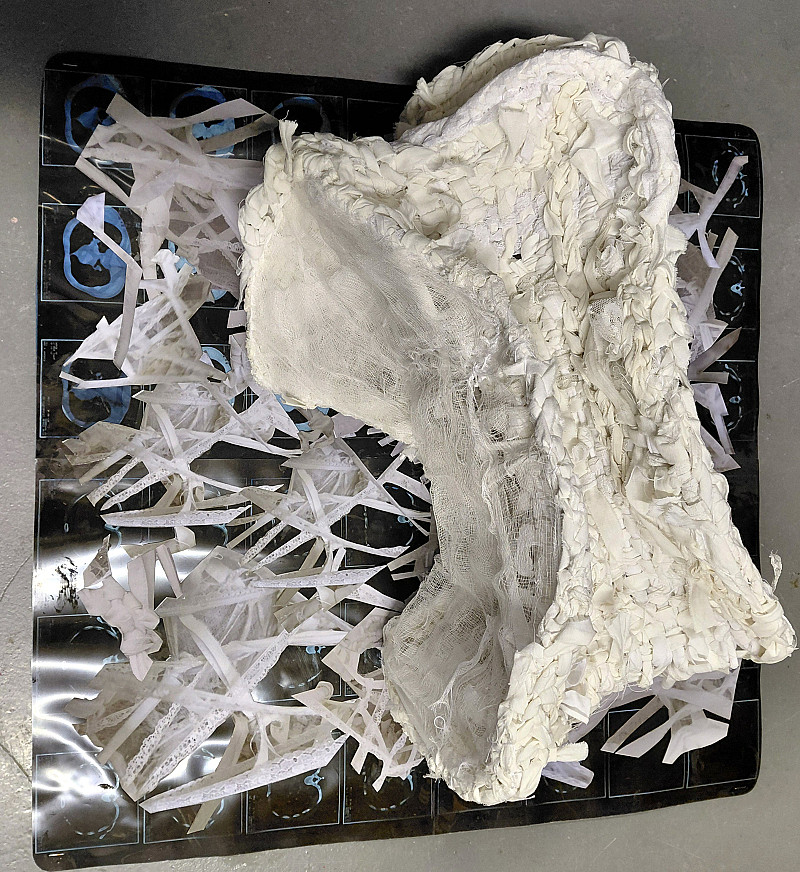
- Fragile Anatomy
- Ingrid Vorwerk Marren
- MIXED MEDIA ON TEXTILE
- 35 x 35 x 49cm.
Ingrid Vorwerk Marren:
Artist Statement
Fibreworks Exhibition — The Viewing Room, 2026
As an Anthropocene and contemporary artist working primarily in fibre, Ingrid uses found and gifted materials and discarded objects that might otherwise end up in landfill. Most of these materials require transformation before they can be incorporated into an artwork. Through her practice, Ingrid draws attention to the potential inherent in mundane, unconventional and overlooked materials, exploring how they can be transformed into unexpected forms and new contexts.
A selection of Ingrid’s works is presented in this exhibition.
Dried, used teabags were collected from obliging acquaintances, painstakingly emptied, sorted by colour and brand, and subsequently assembled and stitched as two-dimensional works. These two dimensional pieces explore the visual and possibilities of repetition, form and pattern.
In the mobile, the teabags are transformed into delicate strands that evoke the appearance and movement of falling rain. Shoots from shrubs pruned in Ingrid’s garden form the structural basis of Red Basket. Remnants of fabric, cut into strips and combined with found objects and other textiles, are woven into its structure.
The work extends the concept of the basket beyond its traditional utilitarian function, transforming it into a sculptural expression.
The free-form sculptures are constructed on pliable wire frames.
In one work, torn sheets are woven onto the frame, while remnants of lace are intricately interlaced through the interior.
In contrast, the second frame is covered with a stiffening material traditionally used in dressmaking, onto which selected pieces of lace have been strategically hand-stitched to create texture, pattern and structure.
Together, these works explore the material, tactile and structural possibilities of fibre within sculptural and artistic practice. They also question conventional perceptions of value by demonstrating how materials that are overlooked, discarded or regarded as having little worth can be transformed into objects of visual and conceptual significance.
