Published 09 October 2026 in Media Blogs
Kai Lossgott
The Shape of What Remains
Exhibition opening speech
Good morning, and thank you all for being here.
What remains after something has served its purpose?
That is the question this exhibition asks. But look closely at its title, because it asks a second thing. Not only what remains — but what shape the remainder takes.
The Shape of What Remains brings together the work of father and son Kurt Lossgott, 1941 to 2025, and Kai Lossgott, born in 1980, exploring their shared fascination with matter, transformation and the traces we leave behind.
Kurt died in May last year. Kai sends his greetings from Munich, and wishes he could be here with us all today.
Kurt was born in the Sudetenland during the upheavals of the Second World War. A working-class refugee resettled in postwar Germany, he trained as a fitter and turner, developing a profound respect for materials and craftsmanship.
In the 1960s, he immigrated to South Africa on a contract as a refrigeration mechanic. Inspired by the kinetic sculptures of Jean Tinguely, he began welding figures from discarded machine parts, marking the beginning of his artistic path.
His lifelong pursuit could be put in five words:
Spirit takes shape in matter.
The work you see here is his answer to that pursuit, and it is a sentence you can read in either direction. He read it forwards. He began with an idea, an observation, a movement — and spent a lifetime finding the material and form that could give it shape.
Rooted in his rural German upbringing and his training as a metalworker, Kurt's Animal Series celebrates form, function and spirit. His sculptures reflect his study and respect for animal anatomy, and his fascination with movement and the natural world.
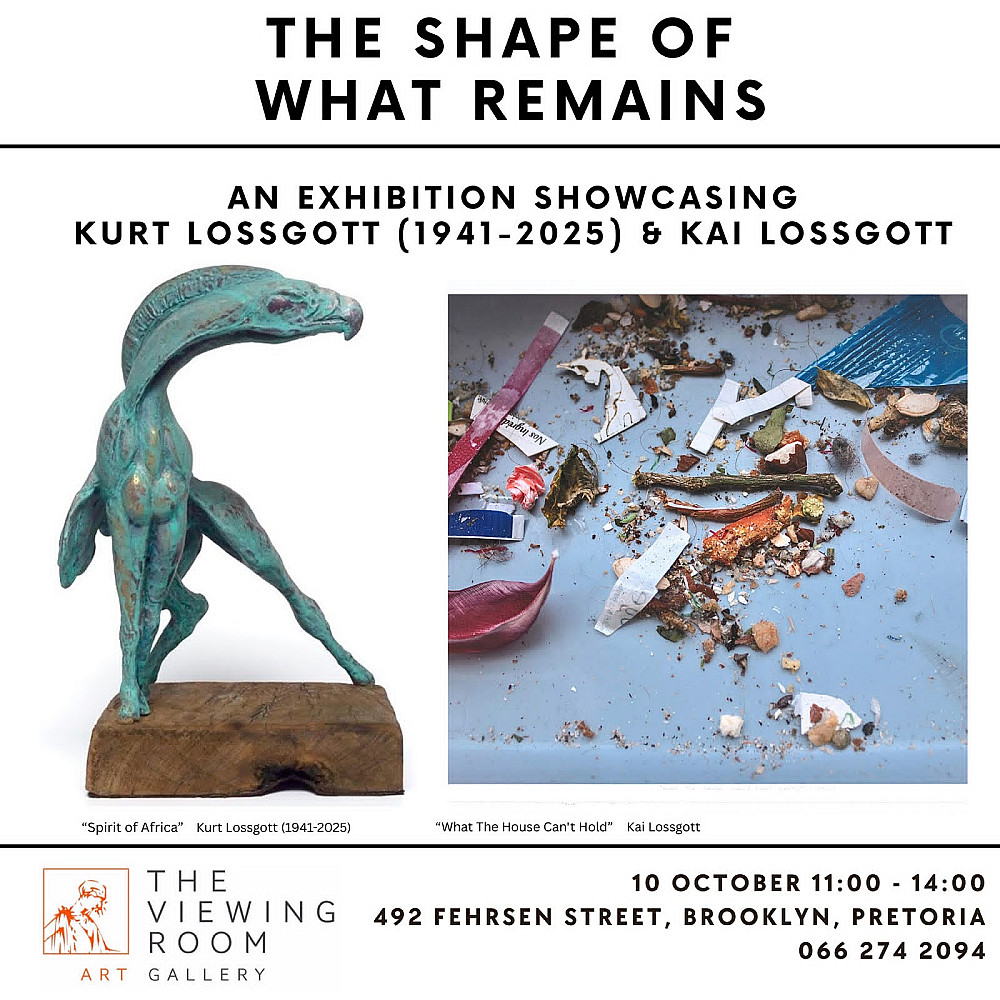
On the poster that brought you here you'll see Spirit of Africa. It is not one animal, but a hybrid of eagle, fish and equine forms, assembled into a single allegorical bronze.
Kurt described its elements in his own words: “Eagle for air. Gill of a fish, for water. Bound by gravity to earth. Fire and thoughts are the intangible elements.”
The figure's eyes are closed. They suggest inner sight — seeing beyond the horizon.
And then there is the "Tomorrow" series, in which Kurt gave body to the ancient mystery of the unknown, or what many cultural traditions have called the veil. These faceless figures evolved into symbols of souls in formation. Each embodies a facet of spirit: waiting, listening, offering or struggling. Late in life he had the revelation that these figures he had made were angels, and renamed the series "Tomorrow's Angels".
Without facial features, they invite projection: teacher, ruler, guardian. They are what remains when you take a person's face away, and they are still unmistakably someone.
Here, too, is the maquette for Madiba and Child. The full work stands four metres tall in bronze at the Nelson Mandela Academic Hospital in Umtata. What is in this room is the small thing the large thing was made from — and what is left of it here, The Shape of What Remains. I invite you to later read the inscription at the base of the sculpture, written by Kai at his father's request in 2023.
I'd also like to read you a little of what his daughter Nadja shared at his funeral.
"Many years ago someone phoned the house. It turned out to be the wrong number. But my dad, being my dad, got chatting to this man, and that started an unlikely friendship. I called it an unlikely friendship because this wrong number turned out to be the Zulu King Goodwill Zwelethini. And I guess that is a story that pretty much sums up my dad. Being open to anyone, willing to talk to anyone. A life philosophy that there are no wrong numbers.
My dad was a true artist in every sense of the word. He said things how he saw them, the man didn't mince his words. He was difficult. He hated dishonesty. He wasn't flawless, and he knew that too.
He appreciated the small things: the colour of a caterpillar in a tree, or the exact blue hue of the sky. He had a beautiful relationship with silence. He was inflexibly original."
He passed some of that on to his son. Kurt's work was also rooted in a profound respect for materials and craftsmanship, and in his fascination with movement and the natural world. From discarded machine parts, he developed figures and animals. Over the years, he returned faithfully to the horse in motion, and later gave form to increasingly symbolic and spiritual figures.
Spirit takes shape in matter. Now take the same question, read it backwards, and turn it towards another kind of remainder.
Kai turns his attention to found objects and post consumer waste as material, through site-specific practice, often on the street, examining what discarded materials can reveal about us, and about a history of making and design now embedded in the ecology.
The photographs on these walls are pragmatic. They look down at the earth, a pavement, a stretch of street — where fragments have been picked up and set out in rows. The supposedly insignificant becomes something to look at closely. The Shape of What Remains.
On the poster, beside his father's hybrid creature, is a dustpan left after cleaning the floor of Kai's studio in Paris at the Cité Internationale des Arts, thanks to the ABSA l'Atelier Award. It tells a story of what happened there. There is also the floor of the Centre Pompidou, where he meticulously arranged the contents of a trash can during a performance. And then there are footnotes to what is left over, for instance the six small assemblages of found objects and notes, titled dis, mem, once, eg., art, fragments of what could become words to give rise to meaning.
The discarded object outlives the moment for which it was manufactured. The material refuses to disappear as quickly as its use-value suggests it should. Kai asks us how our life is implicated in the life of others.
Kurt takes the remnants of industrial production and gives them new bodies. Kai examines the remnants of consumer production and asks what kind of bodies, histories and futures they contain.
The connection is therefore not simply familial. It is material.
Separated by generations and media, their practices meet in encounters with the more-than-human, and a curiosity about the traces left in us. For Kurt it is the animal, or the mystery of the soul. For Kai it is a kind of everyday haunting by the materials that we mould to outlast us.
The unseen acquires a body.
The discarded object becomes evidence.
Matter acquires another life.
Spirit takes shape in matter. And this is the shape of what remains: not permanence, but transformation.
Kurt's legacy endures through his art and the many lives he touched across six decades — through his imagination, generosity and deep conviction, and the many artistic and spiritual communities of which he was part.
And in Nadja's words taken from the eulogy: life ends but love doesn't. Don't wait for permission to make something beautiful. And remember, there are no wrong numbers.
Thank you. The exhibition is open.